Introduction
If you’re in charge of commercial buildings like malls, office towers and hotels, you know that they are usually located in prime spots like metro cities and are usually tough to keep clean with all the limescale, pollution and moisture build-up on glass surfaces. These contaminants permanently bond to the surface of the glass, driving up your cleaning and maintenance expenses while never getting back your newly bought, aesthetic look. However, there do exist solutions like our ClearShield Ecosystem, a thin polymeric resin paste, which cross-links with the silica network present in the glass and prevents the dust and moisture buildup for a long while (up to 10 years). Our Eco-Glass has reduced cleaning frequency by 50%, which we have tried and tested through installing it in global landmarks like the Empire State Building (USA) and Marina Bay Sands (Singapore).
What Are Glass Coatings and How Do They Work?
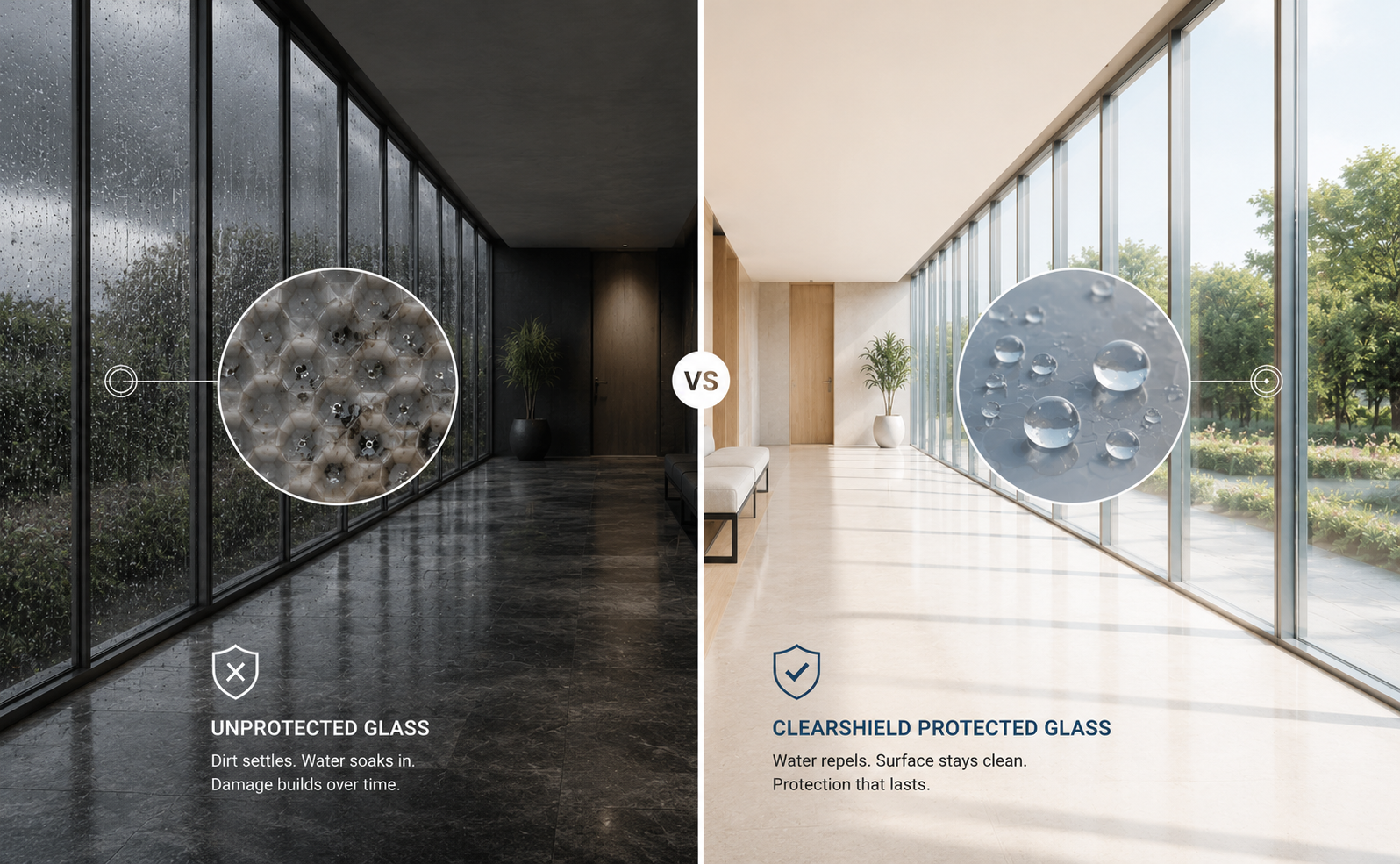
Unprotected glass is similar to a sticky pan. Under a microscope, glass lattice shows itself as a honeycomb-like structure with tiny potholes, demonstrating that the surface is not that smooth after all. Glass coatings, thus, work by forming strong multi-molecular bonds once the polymeric resin coating has been applied.
Our ClearShield Eco-Glass is one such example, where the coating layer chemically bonds with the glass and pads up the tiny potholes in the glass structure. The resin patches up any spots and thus, does not allow moisture, limescale and other pollutants to attach themselves to the glass surface.
Using specialized renovators, professional technicians first remove any pollutants from the glass surface before applying the coating on a recently cleaned pane. This provides maximum durability for the regular problems commercial buildings face – dust buildup, bird droppings, cement dust and harsh weather. It also ensures the hygiene of the glass. Tests at the UK Public Health Laboratory in Porton Down showed that bacteria adhered 32 times less to ClearShield-coated glass compared to ordinary glass upon one wash. Thus, polymeric resin-coated glass like ClearShield becomes perfect for both commercial and specialized usage, like for hospital partitions and kitchen counters.
Average Lifespan of Glass Coatings
It’s really hard to give stiff timelines for the lifespan of glass coatings, but if we are talking about urban office environments with middling pollution levels, premium glass coatings like ours deliver at least 10 years of reliable performance. Your cleaning schedule also cuts down by half since it’s low maintenance and requires only simple wiping to remain effective. However, if you’re near a coastal setting which is exposed to the sea and salt sprays, it lasts for about 5 to 10 years. Finally, for areas with high humidity (hospitals, food & beverage displays), you can expect about 7 to 10 years of protection due to additional bacteria resistance.
Signs Your Glass Coating Is Wearing Off
Have you ever seen how water reacts on a waxy surface? That is how your protected glass must react when you expose water to it. It should bead up and roll off easily. But, if it starts forming puddles and streaks, the protective properties are in danger, and you should call for a reapplication soon before pollutants start damaging the glass.
Some other signs include fingerprints being harder to wipe off and the glass surface feeling stickier during maintenance. You can perform a gloss meter test to confirm if it’s truly fading or just a false positive. If the gloss level drops below 90 GU, it is a clear indicator that you should schedule an appointment soon.
Can Glass Coatings Be Reapplied?
Yes! Similar to your phone’s screen protector, you can simply replace or, in this case, reapply a glass coating if you notice its protection is fading and you were satisfied with its previous performance. To achieve this, glass technicians first wipe off any contaminants remaining on the glass and restore it to its original appearance. If you go ahead with our ClearShield Eco-Glass, you get a minimum of 10 years' durability without having to remove any glass panes or compromising structural integrity. For example, our client, the Suvarnabhumi International Airport in Bangkok, was protected nearly 20 years ago and still boasts stellar glass due to their timely and regular maintenance.
Moreover, reapplying protective coatings is much cheaper due to easier and faster preparation. Since our ClearShield solution has an unlimited shelf life and is non-flammable, it is even safe to apply on-site any time.
What Facility Managers Should Ask Before Choosing a Glass Coating
When choosing the ideal partner for the glass in your commercial building, you must prioritize the longevity of the bond the glass coating system offers and the safety and hygiene conditions of the product. It is also recommended you enquire about the aftercare process. Some hydrophobic coatings are temporary fixes and last just a month or so, unlike our ClearShield Eco-Glass which lasts for up to 10 years.
Ask your suppliers for proof regarding their warranty or longevity claims. It is also important to ask about their preparation process and the ideal environmental conditions for the glass. Many hydrophobic coatings form a thin, mono-molecular coating and fade away quickly, while multi-molecular coatings like ClearShield create a longer-lasting chemical bond. Thus, these temporary coatings are often unsuitable during the construction period and might require replacements if unaccounted for.
Finally, request case studies from similar commercial building environments. Whether you manage a coastal resort or an urban skyscraper, you want to see data on how the coating performs against your environmental threats. Calculate ROI that shows your savings clearly on maintenance if you go ahead with one supplier over another.
Final Thoughts
If you choose to move with ClearShield®, you can be guaranteed that we have solid proof for all our claims in the blog above. Our case studies have shown that our clients have seen a decrease in cleaning labour by 50%, preventing any need for glass replacements. If you’re still unsure, we’d highly recommend a sample glass pane on your building. You can monitor its performance in your environmental conditions before scaling it to your entire portfolio.