

If you live in a city like Bengaluru or Chennai, chances are that the water you use comes under the category of “hard water”. They’re not called hard water because they are solid but because of a high concentration of minerals like calcium and magnesium in them. This will become visible as a light chalky layer on your shower doors, windows and mirrors. If you notice them early and clean your glass every day, they are a light and removable thing but if ignored, they will damage the glass surface permanently, making it look dull and cloudy.
Diluted vinegar solutions and other DIY methods may seem to work in the short run, but most don’t tell you that they can scratch the glass surface if cleaned harshly. Furthermore, commercial spaces and households whose water supply depends on borewells get even more affected, with the glass surfaces tending to get cloudy quicker.
What Are Hard Water Stains on Glass?
Hard water stains are chalky, white spots you can see on glass surfaces, mostly shower doors or windows exposed to high humidity. In metropolitan cities like Bengaluru and Chennai, they appear when mineral-rich water containing calcium and magnesium dries up and leaves behind limescale deposits. Over time, they stick to the glass surface on a microscopic level, making them tough to remove. Due to their crystalline structure, they can also create tiny pits on the glass surface, giving it a blurry appearance. Unfortunately, the hardness level in these cities is high enough to cause severe water stains regularly.
What Causes Hard Water Stains on Glass?
In cities like Bangalore, the underground water has a lot of minerals like calcium and magnesium. When it flows through your water pipes and lets you enjoy your hot shower, it also creates steam and increases the humidity in the shower enclosure. Slowly, the moisture touching your glass turns into hard water deposits. The soap you use also reacts with these minerals, creating more sticky and white spots called soap scum.
Even if your glass installation is not a shower cubicle, it is still at risk of hard water stains in cities where heavy rainfall is common. Since these cities have high humidity, the drying time on glass surfaces increase drastically, creating hard water mineral deposits that are tedious to remove.
Why Hard Water Stains Are a Bigger Problem Than You Think
Hard water stains are not just surface-level deposits. The minerals in hard water (calcium and magnesium) chemically react with the components of your glass and over time, they eat into the glass pores. They also act as magnets for soap scum and other pollutants, creating a residue that is incredibly hard to remove with usual methods. If your glass is installed in a commercial space, your windows will become cloudy and obscure visibility. This makes it crucial for every commercial space owner to guard against hard water stains.
How to Prevent Hard Water Stains on Glass
-
Use a squeegee and a microfiber cloth to dry down wet water as soon as it stops raining or you finish showering. This helps prevent deposits caused by water drying out, which can leave spots or stains.
-
Only use pH-neutral cleaners (with a pH of 7) because stronger alkaline cleaners can damage surfaces faster.
-
If your shower chamber is glass, install a water softener on your showerhead, which replaces hard minerals like calcium and magnesium with sodium. This makes water softer and thus lessens the probability of a limescale build-up.
-
Keep the office space dry by ventilating properly so humidity stays below 60%. Less moisture means water vapor doesn’t stay for long
-
In case your existing glass has minor build-up, you can make use of our aftercare products like Ritec Limescale Remover to clean it on a frequency of once every 3 days to prevent further damage.
Professional Solutions for Hard Water Stains
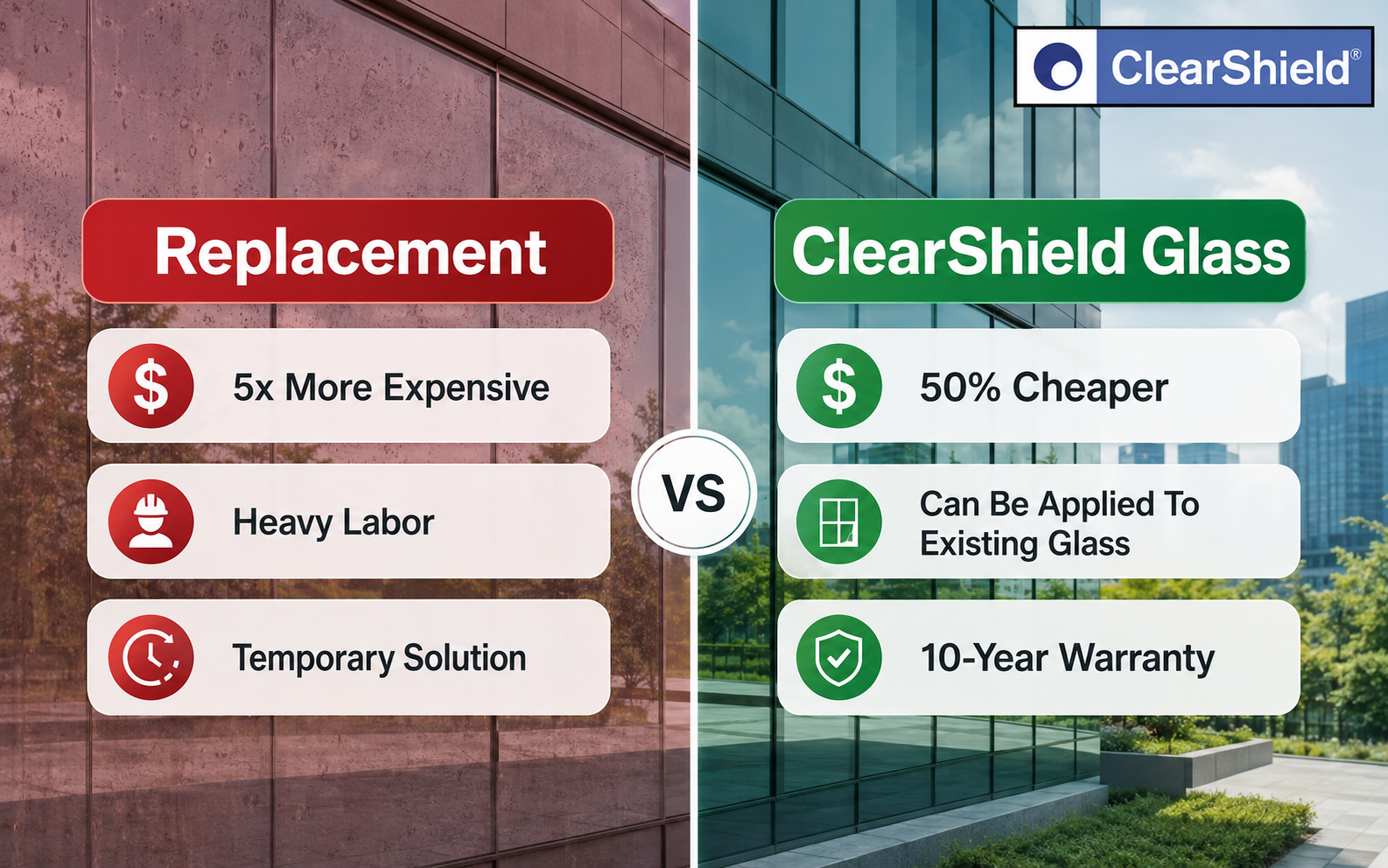
Cleaning by yourself is impossible if there is a lot of build-up, so professionals use the ClearShield Eco-System™ renovators to chemically break the bond between the limescale and the glass without using destructive acids. Then, they apply a special polymer resin coating, such as our ClearShield coating, which chemically bonds with the glass surface and fills in the small pits on the glass lattice permanently. Our ecosystem ensures that the solution lasts for at least 3 years in shower cubicles and 10 years in commercial spaces. ClearShield Eco-Glass makes water slide right off, so minerals and stains don’t stick anymore, keeping the glass clean for a longer time. Moreover, one treatment can keep the glass looking like new for many years as long as it is maintained properly.
If you’re a commercial workspace, we suggest that you get this process done post-monsoon since hard water stains are at an all-time high during that period.
How Long Do Professional Glass Protection Treatments Last?
Our ClearShield® solution is a protective coating applied to glass in high-moisture areas to keep clean. It creates a covalent bond with your glass as a very thin layer, making a barrier that prevents most limescale build-up. The coating lasts about 3 years in humid Indian bathrooms like in Bangalore and Chennai. When installed, the coating needs 48 hours without water to fully set and become effective. Since these places are located in hard water cities, regular showers and minerals from borewell water can wear down the coating over time but proper maintenance helps it stay effective longer.
When Should You Call a Glass Protection Specialist?
If your glass is still cloudy after cleaning or if you feel some pits on its surface after cleaning, it means that your alkaline cleaners are eating away at the glass. To fix this, special solutions or polishing products, which only professionals know, are needed.
For commercial spaces, if you see signs like a sticky film of grime and dust or the air conditioning system seemingly strained because of cloudy glass, get professional service to fix it right away.
Conclusion
Hard water can cause irreversible damage to your glass, yes, but there are some things you can do regularly to prevent substantial build-up in metro cities like Bengaluru and Chennai. Act early when you notice build-up and book professional maintenance after monsoon for the best result. Only then can we get crystal-clear and sparkling glass when we live in humid environments.